
What I said this Sunday – Pentecost
Here’s my sermon for Pentecost Sunday.
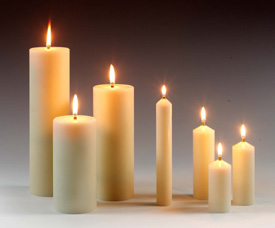
Many churches these days, like our own, use – instead of ordinary candles – oil-filled ones. The advantages are that they are cheaper, cleaner, and never appear to burn down. However long they burn for, they always look just like new. There is a downside though. You buy your oil-filled candle, put it in the candlestick, fill it with oil and light it. It looks wonderful. It burns away and never drips or gets any shorter. The problem is, though, that unless you regularly top it up with more oil, although it always looks alright it is getting emptier and emptier. And in the end it will just go out.
Christians are like oil-filled candles. They look fine on the outside. But they need regularly filling up on the inside – and you can’t tell from just looking at the outside when they’re getting empty. Like an oil-filled candle, a Christian needs a regular filling of the Holy Spirit. Otherwise, although outwardly we may look fine, we just get emptier and emptier – and in the end we stop burning. And simply not notice that we’ve gone out!
Pentecost Sunday – the day the Spirit came, and thousands heard Peter speaking in their own tongues of what God had done. The day that Jesus did as he had promised, and sent the Holy Spirit from the Father to fill up the disciples. But why did the disciples have to wait after the Ascension for Jesus to send the Spirit? And why don’t we, today, seem to experience the Holy Spirit in the way that the disciples did then?
Who is the Holy Spirit? I expect many people in the Church would be hard pressed to answer that question with any clarity if it were put to them. We are clear about God the Father. We know who Jesus is. But not many know who the Holy Spirit is. We talk about one God – Father, Son and Holy Spirit – but there is a tendency to have rather vague ideas about him. The New Testament tells us that the Holy Spirit is the person of the Godhead who dwells in us day by day. He gives gifts to his Church. There are several lists in the New Testament of gifts given by the Holy Spirit. They include such gifts as prophecy, miraculous powers, speaking in tongues as well as more down to earth gifts such as teaching, administration (yes, administration!) and helping others.
This is a Spirit who is at work in the Church – not just then, but now as well. A Spirit who comes to stir up the people of God – the apostles discovered that on the day of Pentecost when the Spirit came not like a gentle breeze, but a violent – think about that word – a violent wind. But if this is what the Holy Spirit is like, what does it mean for us as a group of Christians?
Canon John Gunstone describes in his book LIVE BY THE SPIRIT what preaching at Pentecost used to be like for him before he discovered the reality of the Holy Spirit: Trying to preach on Whit Sunday each year was an embarrassment. I just couldn’t think of anything to say. I rationalised the events narrated in Acts 2 as a dramatic mystical experience that was unique in the life of the apostolic Church, and I warned confirmation candidates not to expect anything like it today… If anyone had asked me (which they never did) how to receive more of the Holy Spirit into their lives, I would probably have mumbled something about saying prayers and receiving Communion.
Peter and the others experienced something dramatic – and Peter, as he preached to the crowds in response to those accusations of drunkenness, told them that God has poured out his Spirit as foretold by the prophetJoel.
That experience gave Peter a vision for the Church, a vision inspired by the Holy Spirit. What is our vision for the Church today? Do we have a vision at all? His vision of the new Church, the new community formed in the power of the Holy Spirit as a direct response to the death and resurrection ofJesusis, perhaps, different from our vision of what the Church should be. We have a tendency to limit our vision – if we have a small vision its easier to believe that it might come about. We lack faith in the power of God.
A report of the General Synod of the Church of England published in 1981 had the following to say about the difference between the Early Church and the Church of today and the way in which we attempt to devalue the message of Acts that the Church should be alive in the power of the Spirit: No amount of sterilisation of the Biblical message, and no amount of critical scholarship, have ever managed wholly to conceal the flow of the Acts narrative, and its message of a Spirit filled community facing persecution, working miracles, rejoicing in the power of God, and generally living a corporate “Pentecostal” life.
No matter how hard we might try, we cannot explain away the fact that the Early Church had something that we haven’t got. It had a freedom, a joyfulness, a carefreeness, a dimension of living in the Spirit, a willing self-surrender, an overflowing love, that does not seem to be evident in our Church today. The difference is highlighted by the fact that following Peter’s sermon more than three thousand people became Christians, yet today Churches inWestern Europe are shrinking. We are so accustomed to small churches that we accept them as normal. Church going in Western Europe is the lowest in the Christian world. Everywhere but in the West the Church is growing – in some places at a phenomenal rate. We need to discard the idea that the behaviour of the apostles at Pentecost and the gifts that they used in their ministry were unique to the Early Church. We need to allow the Holy Spirit of God to guide us and strengthen us and give us the gifts we need so that God’s kingdom might be glorified.
So let us allow the Holy Spirit to direct our lives as individuals and as a community. Because if we allow the Spirit to take control then the Church, in the words of Canon John Gunstone, will: be pulsating with the life of God, subject to his Word, anointed with his Spirit, constrained by his love, preaching his Good News, and ministering with his power.
Let each one of us, on this day of Pentecost, rededicate ourselves to God, Father, Son and Holy Spirit; pray that he will fill us anew with his Holy Spirit as he did the apostles, and that we may be open to the work that he wants to do among us, so that this Church may pulsate with the life of God. And then perhaps we can begin to live out our mission statement which appears at the top of your service sheet every week:
St John’s Church is called by God to be his people through faith in Jesus Christ, in the power of the Holy Spirit: worshipping him, growing in holiness, making disciples and serving others.




 View from the Valley