
Tagged: jesus
What I said last Sunday – What’s the Kingdom worth to you?
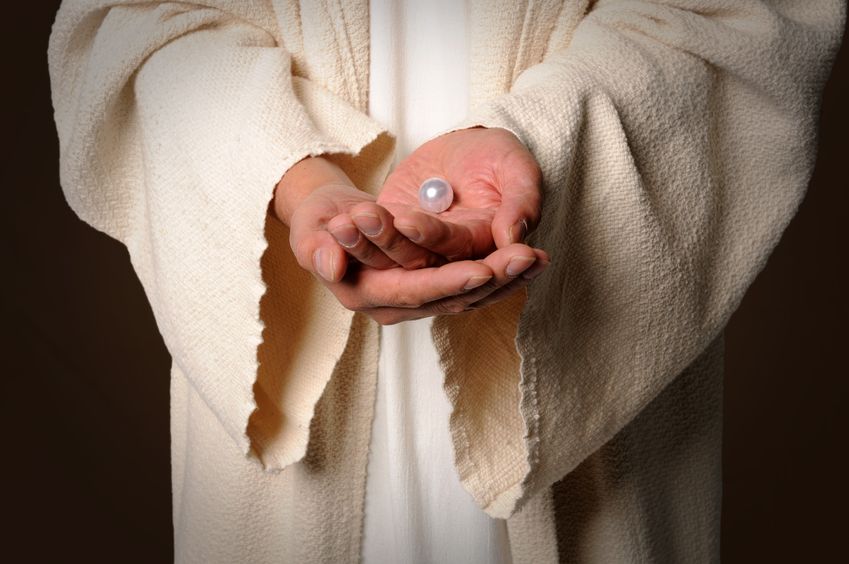
Here is my sermon for Sunday. Jesus is speaking about the Kingdom of Heaven, and what it is worth.
What does it feel like to be able to buy absolutely anything you want, no matter the cost, and not to have to worry about whether you can afford it. Presumably the person who ran a repair garage in Mitcham, has some idea of what that feels like, having scooped the £108 million jackpot on the Euromillions lottery in March of this year. Having given up his garage, he can now buy pretty much anything he likes without batting an eyelid. Even a top of the range executive jet would only set him back a few million. Any time he suddenly thinks “I’d like one of those” he can just indulge himself and not have to worry about his bank account.
Money, of course, won’t buy everything, and often the things we really want in life aren’t things we can just go and buy however rich we might be. And people want all kinds of things. There are internet sites that are specifically designed to let people ask questions about anything, and then others can answer the questions. And one very common question that people ask is “What do you want more than anything else in the world?” It led to some interesting answers as well as answers you’d expect:
- A big fat savings account said one person
- To not ever have to worry about money again, which means that I could shop and buy to my heart’s content
As you’d expect, lots of variations along the lines of lots of money. But they weren’t all about money. Take these desires … Continue reading
What I said for the Feast of the Holy Trinity

Last Sunday was the feast of the Holy Trinity – usually called Trinity Sunday. As those who preach regularly will know it’s not exactly a favourite Sunday for preaching! Here is my sermon.
Isaiah 40.12-17, 27-end; 2 Corinthians 13.11-end; Matthew 28.16-20
How many persons in the Trinity?
Before you answer that, let me tell you a story. It’s not my own story, it’s a story from Donagh O’Shea, a member of the Irish Dominicans.
I want to pass on to you (he says) an insight I received years ago in a small church in Rome: the preacher was a tiny vivid Italian with flashing eyes, and a chasuble and gestures that were both far too big for him. He was preaching in a church beside the Tiber, on Trinity Sunday He told of his earlier years in a parish near Naples. In those days, he said, the days ofhisyouthful enthusiasm, he had begun to wonder if the people in his country parish remembered any-thing of Christian doctrine. They were good people, he said, but he wondered how much they knew of the faith. There was only one way to find out: he had to ask them. So he would ask them, out of the blue, in the middle of a conversation or:when he met one on the road: “Franco, how many Sacraments are there?” or “Cristina, tell me, what are the precepts of the Church?” One day, he said, he was talking with Gianni, a very poor farmer with a large family and hard put to it to feed them. “By the way, Gianni,” he said, “can you tell me how many persons there are in the Trinity?” “Persons in the Trinity!” said Gianni with amazement; “l don’t know. Four, five, ten. I don’t know, and I don’t care. I don’t have to feed them!” Continue reading
Sermon for the 3rd Sunday of Lent

Saint Photini, the Samaritan woman at the well
You may have noticed that I didn’t post a sermon last week. That’s because I didn’t preach. However, the priest I live with did and she has now sent me her sermon so that I can post it for you.
Perhaps you were surprised this morning when you heard the gospel reading – surprised at its length. Apart from Holy Week when we read the passion gospels, it is the longest gospel you will get in the year. Well you may have been surprised at its length, but were you surprised at its content? This is a gospel story full of surprises. Perhaps for us as 21st Century Christians we miss some of those surprises. Continue reading
4th Sunday of Advent – What I said

Yesterday was the 4th Sunday of Advent, and we are nearly at Christmas. The gospel reading is Matthew’s account of how Joseph found out that, despite his reservations, he was going to be a foster-father to a baby boy.
Matthew 1.18-25
Christmas will soon be over. And we’ll be counting the cost of all those unwanted Christmas gifts.
Recent surveys from the online classified advert website Gumtree showed that when the cost of all those unwanted gifts is added up it is estimated that they are worth over £2.4 billion (2011 survey). On average each of us will receive two presents we don’t want worth around £45. And the top givers of unwanted presents (also from the 2011 survey) are mothers, aunts, and mothers-in-law. Continue reading
What I said for Remembrance Sunday

Here’s my sermon for Remembrance Sunday.
Peace is an emotive word. It’s a word that conjures up all kinds of feelings within us. It is something that we all seek in life. We look around our world and see so many places, so many people, that need peace. And yet it seems so elusive. Having now passed the twelfth anniversary of the beginning of the war in Afghanistan, it is, I am sure, something that we all pray and hope for. And yet the reality of our world is that peace is so elusive. Even when not involved in our own conflicts British forces have been involved so much in peace-keeping duties around the world and will continue to be called upon in that role.
Next year we reach the 100th anniversary of the outbreak of The Great War. This year we might think of as the 100th anniversary of the end of peace – the end of a world that had yet to be confronted with the reality of modern warfare. The end of a world in which no-one really could imagine the horrors that the world would face in two world wars and so many other conflicts. And over that 100 years so many have lost their lives – both those who have fought, and so many innocents. And we gather here again to remember those from our own nation who have given their lives, and to commit ourselves to continue to work for the peace for which they fought.
The great paradox of peace is that it is often only achieved as a result of conflict. And since the year 1900 there has only been one year when no-one from the British services died in action – 1968. And today we remember those who achieved the peace we enjoy at the cost of their own lives, those who have given everything for their country, and we pray for those who still mourn for relatives and friends who never returned. And we pray for those who still struggle to come to terms with their experience of war. For the casualties of war include not just those who die, but often those who survive but who have witnessed, or endured themselves, great suffering.
The poppy that we wear is a powerful symbol of our feelings on this day, associated as it is with the fields where so many died in the First World War, growing as such a simple and yet powerful symbol of life and self-sacrifice in a place where so much destruction had been wrought. It is a symbol with a double meaning – it reminds us of those who never returned from the conflicts in which our country has been involved. As such it looks to the past. But the poppy also looks to the future – it is a symbol of hope – for it reminds us that we must all continue to strive for that peace that so many gained for us with their lives. It reminds us that today is a day of both looking backwards and looking forwards. And yet it has been hard not to notice, as I have walked about Caterham this week, that so many people don’t wear a poppy.
I remember as a child almost everyone wearing one. You were unusual if you didn’t. Because most adults, when I was a young child, still remembered the Second World War vividly. They all knew people who had fought and suffered and died. And their parents and my grandparents were the generation who had lived and fought and died in the Great War. So they wore a poppy. Today, those of my age group and younger don’t have the same experience. And so for many remembrance doesn’t seem so important, and those who wear a poppy today stand out. So many people today – in spite of the accessibility of news through television and the newspapers – have no direct experience of war, either as a combatant or as a civilian or as a relative or friend of someone serving.
I said earlier that today is a day both of looking backwards and looking forwards. As you came to church this morning you will have heard our bells ringing. And our bells themselves are a symbol of both mourning and of hope. As always they are rung on this day half-muffled. That means that the bell clapper, the part that strikes the bell, is covered on one side so that it makes that softer, rather sombre sound, every second time the bells ring. So the bells alternate between a rather mournful sounding ring, so appropriate to today and so expressive of our feelings, with a brighter and more joyful sounding ring.
But there is one thing about our bells that you can’t see or hear. The bells originally hung in the church of St Mary at Lambeth, just by the entrance to Lambeth Palace, the London home of the Archbishop of Canterbury in central London by the river Thames. They were brought here in 1975 after St Mary at Lambeth was made redundant. The church is now a garden centre museum. Each bell, in the traditional manner, bears an inscription of some kind. The fifth bell is inscribed with this:
14.8.1914 – 11.11.1918.
Silent I hung in war, I sang the hour of peace.
O England, evermore pray thou that wars may cease.
And on Armistice Day, the day that war ended, the 11th November 1918, that bell that now hangs in our tower, that had hung silently for four years, rang out across London as it sang the hour of peace.
Today is a day of both of looking backwards and of looking forwards. And it is in Jesus Christ that we can find a sense of hope for the future as we remember today those who died as a result of war and conflict. And we find it in the cross upon which he died. The cross reminds us that Christ himself undertook the supreme sacrifice. There is no greater love than to lay down one’s life for one’s friends said Jesus, before he did just that for each and every one of us. Laying down his life for us on the cross, only to rise again on the third day to show us the way to eternal life.
Today we remember all who have died as a result of war – and give thanks too for all those who risked their lives but came home. And as we remember today those who have made that sacrifice of life itself – of giving their lives in the service of their countries and of their families and communities – we can give thanks for them, know the assurance that Christ gives us that they are at rest with him for eternity, and dedicate our lives to the service of the communities for which they died. We must always remember – for it is only when you look back and remember and reflect on the past, that you can look forward and know what you need to work towards in the future. And remembrance really means something when it looks not only back to the past, but spurs us on into the future to continue to work for the peace for which those we remember today died.
Which brings me back to the poppy. There is a famous poem called In Flanders Field by Major, later Lieutenant Colonel John McCrae of the Canadian Army, a surgeon attached to the 1st Field Artillery Brigade. It begins:
In Flanders Field the poppies blow
between the crosses, row on row
that mark our place…
It gave rise to the association of poppies with those who had died and to the custom of wearing poppies for Remembrance. He wrote it in the spring of 1915 after the terrible battle at Ypres. He had just buried a friend, Lieutenant Alex Helmer, who had been killed by a shell. He had carried out the burial service himself since there was no chaplain available. Poppies were growing in the ditches around the cemetery and were blowing in the gentle east wind as McCrae wrote the poem. In fact, McCrae actually threw the poem away, but luckily it was rescued by a fellow officer and sent to Punch magazine which published it the same year. McCrae himself died in 1918.
The poem finishes with a call not to break faith with those who have died.
To you, from failing hands, we throw
the torch; be yours to hold it high.
If ye break faith with us who die
we shall not sleep, though poppies grow
in Flanders Field.
We keep faith with those who died by continuing to commit ourselves to working for peace and justice and reconciliation in our world and in our nation and in our community – those ideals for which so many have fought and died. And for which God gave his Son to die upon a cross.
What I said last Sunday – Trinity 20 (Proper 23)

Here’s my offering for last Sunday. The gospel reading is the story of the ten lepers who are healed by Jesus, but only one of them says thank you.
Why do people find it so difficult, these days, to say ‘thank you’?
Take Christmas and birthdays, for example. When I was growing up it was taken for granted that you taught your children that saying ‘thank you’ was essential – even when you had to say it for things that you didn’t actually want. It was the polite thing to do, and it was expected. It was, as my parents used to say, the ‘done thing’. What was not the ‘done thing’ was to tell your parents exactly what you wanted for Christmas or birthday presents. These days everyone makes sure beforehand that you know exactly what presents they want, which to my mind rather takes the fun out of giving. When I was young you simply had to wait to find out what you were getting – which of course just increased the temptation to go looking beforehand while your parents weren’t around to see what they had bought. My father used to hide the Christmas presents in the loft, which was inaccessible without a step-ladder, so there was no way a small child could investigate – rather sneaky on his part, I thought. Continue reading
What I said on Sunday – Trinity 11 (Proper 14)

“For a man who lives in No. 10 Downing Street, has two multi-million pound homes and an upbringing steeped in privilege, it was the one question which stopped him in his tracks.” So wrote The Daily Telegraph when David Cameron was asked a particularly difficult question during a question-and-answer session recently. For the question was this: “What would your response to Jesus be on his instructions to us to sell all our possessions and give the proceeds to the poor?”
David Cameron, having to respond to such an awkward question, according to The Daily Telegraph went on to say that he thinks the Bible is “not a bad handbook” for life – perhaps understating a little the importance of the Bible for Christians – but admitted that it would be “a little more difficult” to follow the scriptures to the letter and surrender his belongings. He said: “I’m a Christian and I’m an active member of the Church of England, and like all Christians I think I sometimes struggle with some of the sayings and some of the instructions.” Continue reading
What I said on Sunday – Trinity 10 (Proper 13)
I’ve had a couple of weeks off preaching, but was back this Sunday, with the parable of the rich farmer to cope with. It’s more often called the parable of the rich fool.
Colossians 3.1-11; Luke 12.13-21
Finally we’ve had a decent summer. We’ve had the longest period of hot and sunny weather for 25 years, and last Thursday was the hottest day for 7 years. We’re into the holiday season, schools have broken up, and perhaps our minds have not been so much on thoughts of recession but have been taking the opportunity to enjoy life a little more. And then – just when we’re least expecting it, up sneaks today’s gospel to put a dampener on things with its powerful challenge to us to reject the love of money and possessions. And to force home the point Jesus tells the parable of the rich fool, the man who stored up riches so that he would be prepared for the future, but who died before he could use them. Nothing wrong, you might think, in being financially prepared for whatever the future might bring, if we are fortunate enough to be able to make provision. And of course, many of us don’t earn enough to be able to ensure a secure future. But nothing wrong with having a comfortable lifestyle if you’ve earned it, people feel. And yet Jesus has something to say, and something to say quite forcefully, about that.
Being prepared. The parable that we have just heard, usually called the parable of the rich fool, brings to mind what are called ‘preppers’. Now, don’t worry if you don’t know what preppers are – I had never come across the term until this week, and I discovered the term from our daughter. This week she got talking to a guy who uses the same coffee shop as her. Continue reading
What I said on Sunday – Trinity 6 (Proper 9)

Here’s my offering for last Sunday, the gospel reading being Luke’s account of how Jesus sent out the seventy.
Holidays are supposed to be relaxing. So why does getting ready for a holiday seem to be so stressful? Trying to decide what to pack and what to leave behind. Deciding what things might prove to be indispensable. Making sure that you’ve got all the right clothes. Then trying to fit it all into the luggage.
When our children were younger we regularly had holidays in North Wales. The problem with holidays in this country, and particularly in Wales, is that you can never be certain what the weather will be like. So you have to pack clothes for hot weather, cold weather, wet weather – and it all has to go in somewhere. And the children could never quite grasp the concept that the space in a car is limited. A car isn’t like the Tardis, and you can’t pack your entire wardrobe and all your games and your portable TV so you can watch it in your bedroom and your entire family of cuddly toys. Trying to fit everything in was a nightmare. We were even known on occasion – and I’m almost embarrassed to say this – to give in and take two cars because it was easier. We could have done with something like the luggage in Terry Pratchett’s Discworld novels, a chest which had infinite room inside and ran around after you on its own legs. Continue reading
What I said this Sunday – Trinity 3 (Proper 6)
Here’s my sermon for this week. I used the gospel reading, the story of the sinful woman who anointed the feet of Jesus at the house of Simon the Pharisee. Essentially the story of two people who for their own very different reasons sought out Jesus.
In some churches it is the custom for the preacher to give their sermon a title. It’s not something that’s every really taken on in the Church of England, but it’s actually not a bad habit for the preacher to get into. It helps to focus the mind on the what message from the Scripture reading is about. So today, I’m giving my sermon a title: The Importance of Being Earnest. Most of you will, of course, recognise immediately the reference to Oscar Wilde and his most famous play. As I read this gospel reading a number of famous Oscar Wilde quotes came to mind, so as we think about the woman who was a sinner and who washed the feet of Jesus, Oscar Wilde will today help us reflect on what we are being taught by sharing with us some of his most famous quotations. I’m tempted to say, as Oscar himself once said, “I wish I had said that,” but he often puts things so well – and so much better than I can. Continue reading
 View from the Valley