
Category: Sermons
2nd Sunday of Epiphany – Do you ‘get it?’

Here is the sermon I preached for last Sunday, the 2nd Sunday of Epiphany. The gospel reading is the story from John about Jesus meeting Nathanael who becomes one of the twelve. Nathanael only appears in John’s gospel. Bartholomew is listed as one of the twelve in the synoptic gospels but not in John. Traditionally it has been assumed that Nathanael and Bartholomew are therefore one and the same.
1 Samuel 3.1-10; Revelation 5.1-10; John 1.43-end
Sometimes when you hear a joke it simply isn’t funny. No matter that other people laugh at the joke – you simply don’t get the punchline.
Take the joke that won the award for the funniest joke at the Edinburgh Festival Fringe last year, as voted for by the public. I looked it up this week as I was preparing this sermon, but it didn’t seem funny at all – not to me, at any rate. It’s from the comedian Tim Vine: Continue reading
Christmas Day – the sermon from Midnight Mass

We had a really full church for Midnight Mass this year. As always, the gospel reading was the wonderful prologue of Saint John’s gospel.
On Christmas Day in 1977 over half the population of the United Kingdom did exactly the same thing at the same time. 28 million 835 thousand of us in this country sat down to watch the same television programme at the same time on Christmas Day. And it wasn’t the Queen’s speech! It was …….any guesses I wonder? It was the Continue reading
4th Sunday of Advent – and what I said about the Blessed Virgin Mary
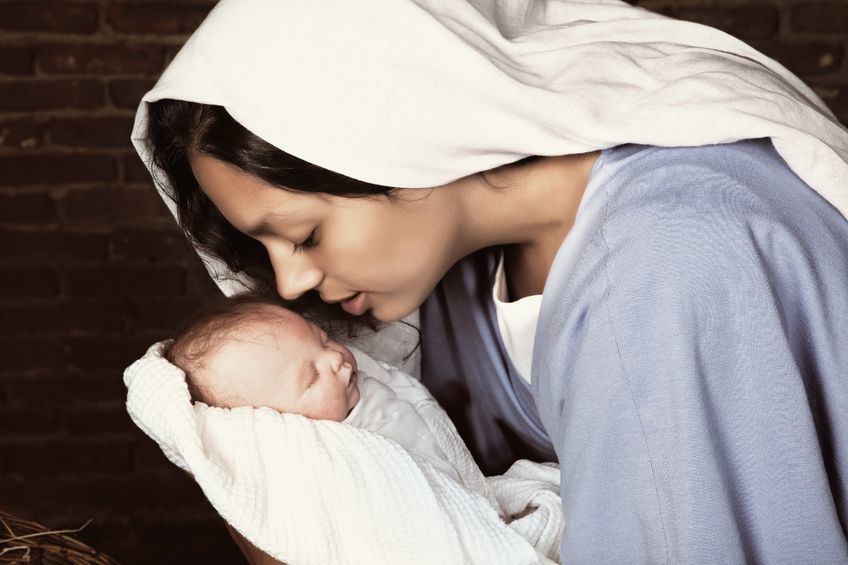
The gospel reading for the 4th Sunday of Advent this year was Luke’s account of the Annunciation, the visit of the archangel Gabriel to Mary to announce the forthcoming arrival of a special child. Here’s what I said.
History is full of ‘What ifs’. What would have happened if particular events had turned out differently. What would have happened if people – world leaders, influential office holders – had made different decisions? What would the world look like today?
In a week that has seen the announcement of the first woman bishop in the Church of England it is interesting to reflect that if a particular person had, at some point in the past, said ‘yes’ instead of ‘no’ the announcement would not have been made. And if you’re wondering who I mean then let me explain. Continue reading
The Feast of Christ the King

Last Sunday was the feast of Christ the King, the last Sunday of the Church Year. I would have posted my sermon sooner were it not for my telephone company. They have just introduced fibre-optic broadband and I had decided to upgrade. The problem was that instead of giving me much higher speeds they managed to give me no speed at all as well as no phone line either. However, everything is now fixed and I am able to post last Sunday’s sermon at last.
Ezekiel 34.11-16, 20-24; Matthew 25.31-36
Last week I began by talking about food. So, this week, just to keep the theme going, I’m going to begin by talking about drink. And I want to ask you, “What is the oldest thing you have ever drunk?”
Well, whatever answer you come up with, I am fairly certain that I can beat it. The oldest thing I have ever drunk was put into a bottle in 1845. I’m talking about a bottle of Continue reading
What I said last Sunday – Be seasoning for the world

Here’s my sermon from this week, the 2nd Sunday before Advent. In the gospel reading from Matthew we hear Jesus giving the parable of the talents.
I’m sure there are many of you who enjoy cooking. And if you are one of those people who don’t enjoy cooking, I’m sure you still enjoy a good meal. Most people enjoy good food of one kind or another, whether it’s spaghetti bolognese or caviar, pizza or the kind of recipes you get on the BBC Good Food website like this one: Roast whole suckling pig with truffle mousse, Jersey Royals and wild garlic. I don’t think I’ll be trying that in the vicarage kitchen!
It’s one of the reasons why all those cooking programmes on the TV are so popular. And whether you are addicted to The Great British Bake-Off or Celebrity MasterChef you will know one thing. You can’t just make a satisfying dish with the main ingredients alone. Along with the basics there will be seasoning, herbs, spices – all designed to give each recipe that special flavour that makes it distinct. Where would a good curry be without curry powder, or jambalaya without Cajun seasoning and smoked paprika.
And so, when we all do our weekly shopping we buy herbs and spices as well, and in many a kitchen you will see a rack of little jars just waiting to do their job of enhancing the cooking. In our house we like cooking, and when I counted up yesterday I discovered that we have 25 herbs and spices out in the kitchen, as well as a few more in the cupboard. So I was surprised to read the results of the survey that Kenwood, the well-known maker of kitchen appliances, has just carried out. No, Kenwood aren’t sponsoring my sermon, but it was reported in The Times this week. Kenwood discovered that the average Briton only cooks four foreign dishes – spaghetti Bolognese, curry, risotto and stir-fry – and a quarter of those are made with ready-made sauces. And because of that the average household has just ten types of herbs and spices in the kitchen cupboards. The thing is, of those ten herbs and spices, half of them have never been opened. And Kenwood reckon that the value of unopened herbs and spices just sitting, totally unused, in people’s cupboards, is £240 million. What is the point of buying herbs and spices – some of which can actually be quite expensive in terms of cost per weight – and just putting them in the cupboard to sit there unused?
Well, that brings me to our gospel reading this morning. We hear a story that Jesus tells about three servants and their master. He is going on a long journey, and he calls the three in front of him. Jesus tells us how he entrusts his property to them to look after while he is away. To one he gives five talents, to the second two talents, and to the third one talent. Nowadays the word talent means something quite different from what Jesus is talking about. Today it means personal qualities or gifts. In the New Testament the talent was a unit of money – and it was worth a great deal. A talent was as much as a labourer would earn in fifteen years, so the three servants are being given huge amounts of money to look after.
And so we hear how the first servant goes off and trades with his master’s money and manages to double it. The second servants does the same. But the third just goes and digs a hole in the ground and buries the money he has been given. And then, after a long time, back comes their master, and he wants to know what they have been doing with his money, and how much profit they have to give him back. He’s clearly pleased with the first two – they have doubled his money for him. So much so, that he gives them more responsibility and he says to each of them, “Enter into the joy of your Lord.” But what happens when he comes to the third servant? Well, you can’t have missed it – he’s extremely angry. The third servant has done nothing with the money. He’s just buried it in a hole in the ground because he was worried about of losing it, or getting things wrong, and being unable to pay his master back. And he was so worried, that he didn’t even put the money in a bank where it would have made some profit. His master is not happy. The money he has is taken from him and his master finishes with those disturbing words: “As for this worthless slave, throw him into the outer darkness, where there will be weeping and gnashing of teeth.”
Now, it’s quite important to understand where this story comes in the context of Jesus’ life and ministry. He is on the brink of his passion and he is telling this story in the context of his ultimate return. And it is clearly a story about how Jesus gives his servants what they need for his kingdom while he is not there with them. That is how those to whom Matthew wrote his gospel would have understood it. And they would have understood that it was posing a very serious question for them. Jesus has gone away. And since he ascended, and then sent the gift of the Holy Spirit to his followers, they have been waiting for him to return. He hasn’t done so yet, and rather like the three servants in the story they don’t know when their master is going to return. And so the question that is before them is this: Jesus has left for you everything you need in order to carry out the work of his kingdom until he returns – how are you using it?
Are you using the gifts that Jesus has given you as you go about your daily lives, or are you just sitting on them and keeping your head down?
Like all the stories that Jesus tells, this is not just a question for those who first heard Jesus tell the story. Or for those to whom Matthew wrote his gospel. It is a question for each one of us here this morning. How are we using what Jesus gives us for the work of the kingdom, for our ministry as his body here on earth until he returns? Or have we just buried everything he gives us away because we are afraid of messing up? Or because we don’t want to be noticed?
Each Sunday we gather here for worship, and to come together around the table as we share in the bread and the wine of the body and blood of Jesus. He gives himself to us. He strengthens us for our day to day life in his world. He has called us to be his followers, and sends us out into his world to make a difference. But do we? We are called to be seasoning to our world. But are we? So often, as Christians, we may feel all geared up on a Sunday morning to get out there and really be the Christian that we know Jesus wants us to be and that we know we want to be. And yet once we go home and get back to the trials and tribulations of getting through another week it all gets kind of watered down somehow. Those good intentions somehow fly out of the window, and then next time we’re back in church we go through the cycle again – “Yes, Lord, I’m ready to do your will!” until we get home and back to reality again. That, of course, is what happened to Peter – who said he would follow Jesus anywhere and would never deny him – and yet when the crunch came that’s exactly what he did. We’re in good company. We though, now live in the light of the resurrection. And that makes a difference. And what we cannot avoid is the message of this story of Jesus – use what you have been given for the kingdom. For if you don’t, when I return I will pass judgement.
Think back to those jars of herbs and spices. Don’t worry, I’m not going to ask you to think about what kind of herb or spice you think you are! I’ve been on enough clergy training conferences where we have to do that sort of thing! But just think about this. The purpose of herbs and spices is to improve the dishes to which they are added. The jars need to come out of the cupboard and be in the kitchen where they can be reached and used. Those jars that just stay at the back of the cupboard, unopened and unused, are a waste of space, and in the end when one day the cupboard is tidied and cleaned they’ll just be thrown into the bin – out of life and no longer of any use.
As we leave church each Sunday, are we going to be like the unused jars in the cupboard that no-one sees or uses, or the ones that are out ready and waiting for the opportunity to be used to improve the cuisine.
Jesus is telling us this morning exactly what we are to be like. As his servants he gives us the gifts and the talents that we need in order to carry out his work, in order to go out into his world and make it a better place and enable people to have a better life and a relationship with him. It is up to us put those gifts and talents to good use day by day, and not to go home and forget about them until next Sunday. Are you a jar with the top still securely on and the wrapping in place – or are you a jar with your top off just waiting to be used wherever you’re needed. Jesus, earlier in this gospel, says to his disciples, “You are the salt of the earth.” Are you prepared to be seasoning for his world? Continue reading
Remembrance Sunday at Chaldon
The priest I lived with was taking the service at Sts. Peter and Paul, Chaldon – it’s one of the other churches in our team ministry. Since Remembrance Sunday a number of people who were there have asked for a copy of her sermon, so I’m posting it here.
This year on Remembrance Sunday, and again on Armistice Day on Tuesday, our thoughts will go back to the anniversary of the First World War, which started on 4th August 1914 and by this time a hundred years ago had already cost many lives. The first battle of Ypres raged through October and November. In those two months there were some 54,000 British casualties, 80,000 German casualties, around 86,000 French casualties and the Belgium army was virtually obliterated. These losses are just so great that we find it hard now to imagine the impact or understand why such massive loss of young lives was tolerated. Continue reading
A sermon for Remembrance Sunday

If I should die, think only this of me:
that there’s some corner of a foreign field
that is for ever England.
The opening lines of The Soldier, the poem by Rupert Brooke, one of the Great War poets, and perhaps the most famous lines from the great and moving body of poetry that they gave us.
If I should die, think only this of me:
that there’s some corner of a foreign field
that is for ever England.
This year has brought us to, as we all know, the centenary of the outbreak of World War One – a war which was to dwarf all wars which had preceded it, a war which became known as The Great War, the war to end all wars, and which left an indelible mark upon the consciousness of a generation, and a mark that we still feel today. And as we reflect and remember this morning I just want to tell the story of one particular corner of a foreign field – but whether it is for ever England we shall see. And as well as being the story of a foreign field, it is also the story of two men who died during the Great War. The whole of the war separated the deaths of these two particular men. We begin with John Parr. Continue reading
What are you wearing? A sermon for Bible Sunday

Last Sunday we had, in the Church of England, the option of keeping either the Last Sunday after Trinity (Proper 25 in the Revised Common Lectionary) or Bible Sunday. I opted for the latter as it never hurts for people to be reminded of the centrality of Scripture. I decided to preach on the New Testament reading from Saint Paul’s letter to the Colossians.
I’ve always liked clothes that make a statement.
By that, I mean clothes that really do make a statement – t-shirts, sweatshirts and the like that have a message written on them. I have a growing collection of t-shirts at home that come out for holidays in the sun, or days off when the weather permits.
One I particulary like says right across the from for anyone I meet to read, “I don’t know everything, but I can see how from your point of view it might look that way.” But one of my favourites has drawings of cats down the front with a quotation, “Time spent with cats is never wasted,” with the name of the author of the quotation. Anyone know who said that? Sigmund Freud, the famous founder of psychoanalysis. Who’d have thought that Freud was into cats? Continue reading
The Great Banquet – Proper 23

The priest I live with was preaching on the 19th October. We were then off the next day on the delights of our five-yearly diocesan clergy conference, hence the late posting of what she said. Better late than never, here is Mother Anne-Marie’s sermon on the parable of the wedding banquet in Matthew.
In this morning’s gospel we have an image of the Kingdom of Heaven as a great wedding feast. A wonderful meal is awaiting the guests, the wine will flow and no doubt there’ll be music and dancing – a really good time to be had by all. It’s a wonderful image of what awaits us in God’s Kingdom. And here as the church of God, we are a microcosm of that Kingdom, we are meant to be a taste of the Kingdom to come. Here within this church people should catch a glimpse of that glorious kingdom, with its upside down values, its joy, its love, its merriment, and its embracing of life in all its fullness. But the image Jesus gives us in the Gospel reading tells us that however good it is, there will be people who don’t want to come. The King has many refusals to his invitation to the great wedding banquet which tells us that God is aware that many will refuse his invitation to be part of his Kingdom both in this world and the next. Continue reading
Dealing with authority – what I said last Sunday

Last Sunday we heard how the religious leaders demanded to know from Jesus where his authority came from. Here’s what I said.
Ask any parent and they’ll tell you – being a parent is one of the most difficult things you’ll ever do in your life. And it doesn’t stop when the children leave home. And all the while you have at the back of your mind that you must always treat them carefully because they’ll be choosing the care home you go to when you’re old. My favourite quotation about parenting and children is from Erma Bomberg, an American humourist who wrote a newspaper column about family life in the latter half of the last century. She wrote: When my children become wild and unruly, I use a nice safe playpen. When they’re finished, I climb out!
Continue reading
 View from the Valley