
Category: Sermons
What I said a couple of weeks ago – 3rd Sunday of Lent
It was only while getting ready for the services tomorrow that I realised I had forgotten to post my last sermon which was two weeks ago now. Usually someone in the congregation reminds me, but this hasn’t happened on this occasion. Perhaps the sermon wasn’t that memorable and no-one wanted to read it again! Last week being Mothering Sunday I put together an interactive talk using Powerpoint so nothing to post.
Anyway, here is my sermon for the 3rd Sunday of Lent which I based on the psalm for the day.
Exodus 20.1-17; Psalm 19; John 2.13-22  I’m sure that all of you hear consider yourselves to be good, upright, law-abiding citizens, who would never wittingly break any laws or statutes currently in force. Even if you don’t always agree with them. Not even ever breaking the speed limit or trying to be creative with your tax return.
Of course – that rather depends on you knowing the law. Just in case you should want to brush up your knowledge of the law, to avoid inadvertently committing any breaches, the British Library rather conveniently keeps copies of all the laws in force – you can go and consult them if you wish. Though I wouldn’t advise it. Apparently our general laws and statutes currently fill 358 volumes, while local laws and other private acts fill another 682 volumes. Adding in even more volumes containing statutory instruments that’s 104 shelves of the British Library for you to work your way through. However, this morning, to help you stay within the law, I’d just like to reminder you of some laws that are currently in force – I wouldn’t want you to inadvertently run foul of the authorities. Continue reading
What I said this Sunday – 2nd Sunday of Lent
Here’s my sermon from this morning.

Mark 8.31-end
How much are you prepared to suffer for what you believe in? And I mean suffer voluntarily? How much unnecessary suffering would you willingly take on because you thought the end result was worth it?
Would you, for example, be prepared to suffer as much as the Liverpudlian comedian John Bishop has over the past few days?
Well, John Bishop has been raising money for Sport Relief. He was sponsored to travel from Paris to London. And he did it in five days. Why so long? It was how he did it that was the problem. Because he cycled, ran and rowed his way. He has cycled 185 miles, run three marathon distances and rowed across the channel. He has battled exhaustion, severe aches and pains, sickness, sleep derivation and was in severe pain for the final stint. He has had his legs strapped up, and had regular ice treatments and massages, and in the final stages was diagnosed with shin splints – an injury caused by severe stress on the tibia. And he kept going. And on Friday he finally hobbled up the Mall into Trafalgar Square and up the steps of the National Gallery to go through the finish archway, to the strains of the Liverpool anthem “You’ll never walk alone.” Continue reading
What I said on Sunday – Transfiguration Sunday
Last Sunday was what we call in the Church of England the Sunday next before Lent. It is also known as Transfiguration Sunday, hence the theme of my sermon. We had a baptism during the service which I mentioned in the sermon – I’ve removed the name of the baby being baptised.

Mark 9.2-9
I don’t know about you, but personally I’ve not climbed many mountains in my life. Well, strictly speaking I don’t suppose I can claim to have climbed any, since I always take the easy route – train or chairlift.
I remember in particular the time when we took the train to the top of Mount Snowdon in Wales during a holiday, and although Jesus and his companions walked to the top of their mountain, we had a similar experience at the top – we were overshadowed by cloud. It was a gloriously sunny day. No clouds in sight. An ideal day for going up a mountain – the views, we assumed, would be spectacular. The train set off on its journey to the summit – and it was about a hundred feet up that we entered the cloud. And this was no ordinary cloud. All the way up it rained, it was freezing, and the wind was so bad that it was impossible to keep the cold and the wet out of the carriages. At the summit station the children flatly refused to climb the short path to the actual summit of the mountain. They kept warm in the station whileAnne-Marieand I braved the elements and climbed the last few feet – I’m not quite sure why, since the only view we got was about six feet in front of us, since it was so dark and the rain was pouring down. Continue reading
What I said on Sunday – 2nd Sunday before Lent
A little late this week as I have been away since Sunday on a conference, but here at last is what I said last Sunday.
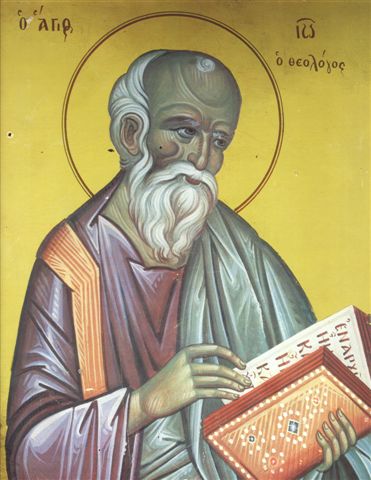
On the wall of my vestry, amidst all the untideness and clutter typical of churchy vestries, hangs an icon. It is an icon of Saint John the Evangelist. And one thing that you will always see in an icon of Saint John is a book that he holds in his hands. Usually the book will be open – in our icon it is nearly closed. But if you look closely you can just make out enough of the words written in the book to recognise – if you can read Greek – the opening words of Saint John’s Gospel. The opening words of his Gospel are such powerful words – words that still, down the centuries, resonate – even though they may not be immediately understandable. John knew how powerful words could be.
I can still remember many of the playground rhymes and chants that I used as a child – I’m sure many of you can remember those you used as well. One of them, which I think was more or less universal, was “Sticks and stones may break my bones, but words can never hurt me.” Even at the time I thought it was a suspect saying. Continue reading
What I said on Sunday – 3rd before Lent
Slightly late this week. I spent rather a lot of time yesterday shovelling snow and trying to get the car as far as the main road!

Those of you who have ventured beyond the door of my study will probably have noticed the icons that hang upon the wall. Icons, of course, are a feature of Orthodox churches and Orthodox worship, but are increasingly finding their way into the devotion of other Christians. One example I have here with me this morning. This is what is known as a travelling icon. It is a small, foldable, set of icons depicting Jesus in the centre, with his mother Mary on the left and John the Baptist on the right, and is designed so that it may be taken with you when you travel away from home.
If you are into art in any way you may have immediately thought – ah, that’s a triptych. You might not – but don’t worry, I’m about to explain what a triptych is. Continue reading
What I said this Sunday – Epiphany 4
Here – a little late this week – is what I said on Sunday
Deut. 18.15-20; Rev. 12.1-5a; Mark 1.21-28
I’ve never been a great one for joining protest marches and rallies though, over the years, I have been on the odd one or two. But I’ve always been glad that I live in a country where we have the right to protest. One of the cornerstones of our democracy is the right to protest about things over which we feel strongly and the right to speak out against those in authority when we believe they are wrong. We believe that in a democratic society people have the right to speak out about issues that they disagree with, and the right to do that by gathering in public.
Sometimes those protests might be on a small scale – as when a number of us from the local community protested over the closure of the Marie Curie Hospice in 2009. Sometimes, of course, they can be on a bigger scale, such as the protest against student fees last November, which marched through the streets of London to meet up with the protest against corporate greed in the City of London – the notorious camp outside St Paul’s cathedral. Continue reading
Four nouns in search of a verb
As I said in my last post, I was not at St. John’s this week. As it was the Week of Prayer for Christian Unity I had been invited to the United Reformed Church in Caterham.
Things are done differently there as you’d expect. I had to give my sermon a title which was Four nouns in search of a verb. I also had to choose three readings with introductions. I came up with these:
Zephaniah 3.16-end: The Father says “I will gather you together.”
1 John 4.9-15: The Spirit says “I will dwell in you.”
Matthew 18.19-22: The Son says “I will be among you.”
Here is my sermon on the the theme of Unity.

Education isn’t what it used to be! As parents, and now grandparents, my wife and I have both felt that, as we have seen our children and grandchildren pass through the education system. It’s not really true, of course, but we all feel from time to time that the way we used to do things was better in the past. I remember not long ago, one of our daughters was struggling with one of her children over his grasp of English grammar. The problem was that when we tried to help she didn’t know what we were talking about when we started trying to explain parts of speech, sentence construction and so on. And almost with one voice we both said: ‘The trouble is you didn’t do parsing at school.’ Continue reading
What the priest I live with said this Sunday – Epiphany 3
I was elsewhere this Sunday and so Mother Anne-Marie was in charge at St. John’s. Here’s her sermon.

When did Christmas begin?
When did it begin, not this last year, which in the shops was probably September, but when did it originally begin?
Well, you might want to say “When Jesus was born of course”. Well perhaps – did they have birthday parties in 1st century Palestine so in Nazareth Mary and Joseph hung up balloons and sent out invites to Jesus’s fifth birthday party and thought of age appropriate games to play, or find a children’s entertainer to invite. I doubt it! As in many societies birthdays were not remembered or celebrated in the way that we place such significance on our birth date. So Christmas didn’t begin on Jesus’s first birthday. Continue reading
What I said this Sunday – 2nd Sunday of Epiphany
Here’s my sermon from today’s Parish Mass. The Old Testament reading tells the story of the call of Samuel while the Gospel is the call of Nathanael.

1 Samuel 3.1-10; Revelation 5.1-10; John 1.43-end
There’s nothing worse than being with a group of people and someone tells a joke – and you’re the only one that just doesn’t get it. Everyone else thinks its hilariously funny and you just don’t get the punchline.
Every year during August Edinburgh holds its world famous festival, and long with the festival you will find the fringe – a range of additional shows that has grown up around the official festival. And in recent years there has been a competition, with a cash prize and voted for by those attending, for the best 10 jokes of the Edinburgh Fringe. This annual joke competition is now so popular it’s reported in all the quality press – even The Times and The Telegraph. Now, I think I’ve got a pretty normal sense of humour, but every year I just don’t see the point of half of the jokes listed. Often it takes a while before I can even see why it’s supposed to be funny. Take the winning entries from the last three years – none of which I found funny even after I had understood the point of the joke. I’m going to roadtest them on you now.
2009 – comedian Dan Antopolski won with this one-liner: Continue reading
What I said at Midnight Mass
Well, the Christmas services are now all over. Here’s the sermon I preached at Midnight Mass this year. As always at the Midnight Mass, the gospel reading was the prologue from Saint John’s Gospel.

Scene from the crib at S. John's, Caterham Valley
John 1.1-14
“The light shines in the darkness, and the darkness did not overcome it.” (John 1:5)
God had been very busy creating things. And God said: Wow! I’m worn out. I’ve just created a 24-hour period of alternating light and darkness on Earth. The angel said: What are you going to do now? And God said: I think I’ll call it a day!
One of our most basic fears is fear of the dark. Today, with electric lighting inside and out – unless you live in Woldingham, of course, where the residents don’t want street lights – we rarely have to face the dark unless it is our own choice. At the time of Jesus, as night fell, the only protection against the dark was a candle or an oil lamp. Continue reading
 View from the Valley