What I said a week last Sunday – Holy Cross Day


Following three weeks away on annual leave, I’m finally catching up with everything that piled up during my time away. Apoologies for this being somewhat late, but here is my sermon for a week last Sunday. We kept the feast of the Exaltation of the Holy Cross, which is actually the 14th September. We held it a day late.

“I’ll give you something to believe”, said the White Queen to Alice, “I’m just one hundred and one, five months and a day.”

“I can’t believe that!! Said Alice.

“Can’t you?” the Queen said in a pitying tone. “Try again: draw a long breath, and shut your eyes.”

Alice laughed. “There’s no use trying,” she said: “one can’t believe impossible things.”

“I dare say you haven’t had much practise,” said the Queen. “When I was your age, I always did it for half an hour a day. Why, sometimes I’ve believed as many as six impossible things before breakfast.” Continue reading

What I said on Sunday – The Blessed Virgin Mary


7914342_m

Last Thursday was the feast of the Blessed Virgin Mary – also known as the Assumption in the Roman Catholic Church and The Dormition in the Orthodox Church. We transferred the feast to the following Sunday. Here’s what I said.

Revelation 11.19-12.6, 10; Luke 1.46-55

It’s not easy knowing whether someone is called to be a priest in the Church. For the Church is not like other careers. It doesn’t matter how highly qualified you are or how able you might be – the Church has to decide whether God actually wants you to be a priest regardless of what your other qualifications might be. Important, of course, for the church to be able to discern the kind of people that God is calling. So the Church provides a very helpful 24-page document entitled Criteria for Selection for the Ordained Ministry in the Church of England. And the introduction to the guide covers such aspects of the selection procedures as:

  • The vocation criterion
  • Gathering evidence
  • Assessing potential and risk
  • Developmental and non-developmental issues

and the guide goes on to cover various aspects of a person’s makeup: spirituality, relationships, personality and character, leadership and collaboration, faith and so on – and I particularly like this one – quality of mind. All important stuff, of course. I wonder whether God’s ever read it? Continue reading

What I said on Sunday – Trinity 11 (Proper 14)


16408987_m

Luke 12.32-40

“For a man who lives in No. 10 Downing Street, has two multi-million pound homes and an upbringing steeped in privilege, it was the one question which stopped him in his tracks.” So wrote The Daily Telegraph when David Cameron was asked a particularly difficult question during a question-and-answer session recently. For the question was this: “What would your response to Jesus be on his instructions to us to sell all our possessions and give the proceeds to the poor?”

David Cameron, having to respond to such an awkward question, according to The Daily Telegraph went on to say that he thinks the Bible is “not a bad handbook” for life – perhaps understating a little the importance of the Bible for Christians – but admitted that it would be “a little more difficult” to follow the scriptures to the letter and surrender his belongings. He said: “I’m a Christian and I’m an active member of the Church of England, and like all Christians I think I sometimes struggle with some of the sayings and some of the instructions.” Continue reading

What I said on Sunday – Trinity 10 (Proper 13)


9729838_m
I’ve had a couple of weeks off preaching, but was back this Sunday, with the parable of the rich farmer to cope with. It’s more often called the parable of the rich fool.

Colossians 3.1-11; Luke 12.13-21

Finally we’ve had a decent summer. We’ve had the longest period of hot and sunny weather for 25 years, and last Thursday was the hottest day for 7 years. We’re into the holiday season, schools have broken up, and perhaps our minds have not been so much on thoughts of recession but have been taking the opportunity to enjoy life a little more. And then – just when we’re least expecting it, up sneaks today’s gospel to put a dampener on things with its powerful challenge to us to reject the love of money and possessions. And to force home the point Jesus tells the parable of the rich fool, the man who stored up riches so that he would be prepared for the future, but who died before he could use them. Nothing wrong, you might think, in being financially prepared for whatever the future might bring, if we are fortunate enough to be able to make provision. And of course, many of us don’t earn enough to be able to ensure a secure future. But nothing wrong with having a comfortable lifestyle if you’ve earned it, people feel. And yet Jesus has something to say, and something to say quite forcefully, about that.

Being prepared. The parable that we have just heard, usually called the parable of the rich fool, brings to mind what are called ‘preppers’. Now, don’t worry if you don’t know what preppers are – I had never come across the term until this week, and I discovered the term from our daughter. This week she got talking to a guy who uses the same coffee shop as her. Continue reading

What I said on Sunday – Trinity 6 (Proper 9)


17933656_m

Here’s my offering for last Sunday, the gospel reading being Luke’s account of how Jesus sent out the seventy.

Luke 10.1-11, 16-20

Holidays are supposed to be relaxing. So why does getting ready for a holiday seem to be so stressful? Trying to decide what to pack and what to leave behind. Deciding what things might prove to be indispensable. Making sure that you’ve got all the right clothes. Then trying to fit it all into the luggage.

When our children were younger we regularly had holidays in North Wales. The problem with holidays in this country, and particularly in Wales, is that you can never be certain what the weather will be like. So you have to pack clothes for hot weather, cold weather, wet weather – and it all has to go in somewhere. And the children could never quite grasp the concept that the space in a car is limited. A car isn’t like the Tardis, and you can’t pack your entire wardrobe and all your games and your portable TV so you can watch it in your bedroom and your entire family of cuddly toys. Trying to fit everything in was a nightmare. We were even known on occasion – and I’m almost embarrassed to say this – to give in and take two cars because it was easier. We could have done with something like the luggage in Terry Pratchett’s Discworld novels, a chest which had infinite room inside and ran around after you on its own legs. Continue reading

Munch with Music – July 3rd


Our monthly free lunchtime concerts continue this coming Wednesday.

This month we welcome David Hughes (baritone) and Chris Underhill (piano).

All welcome – tea, coffee and biscuits provided free from 12.15pm – performance from 12.45pm to 1.30pm. Bring you own lunch if you wish.

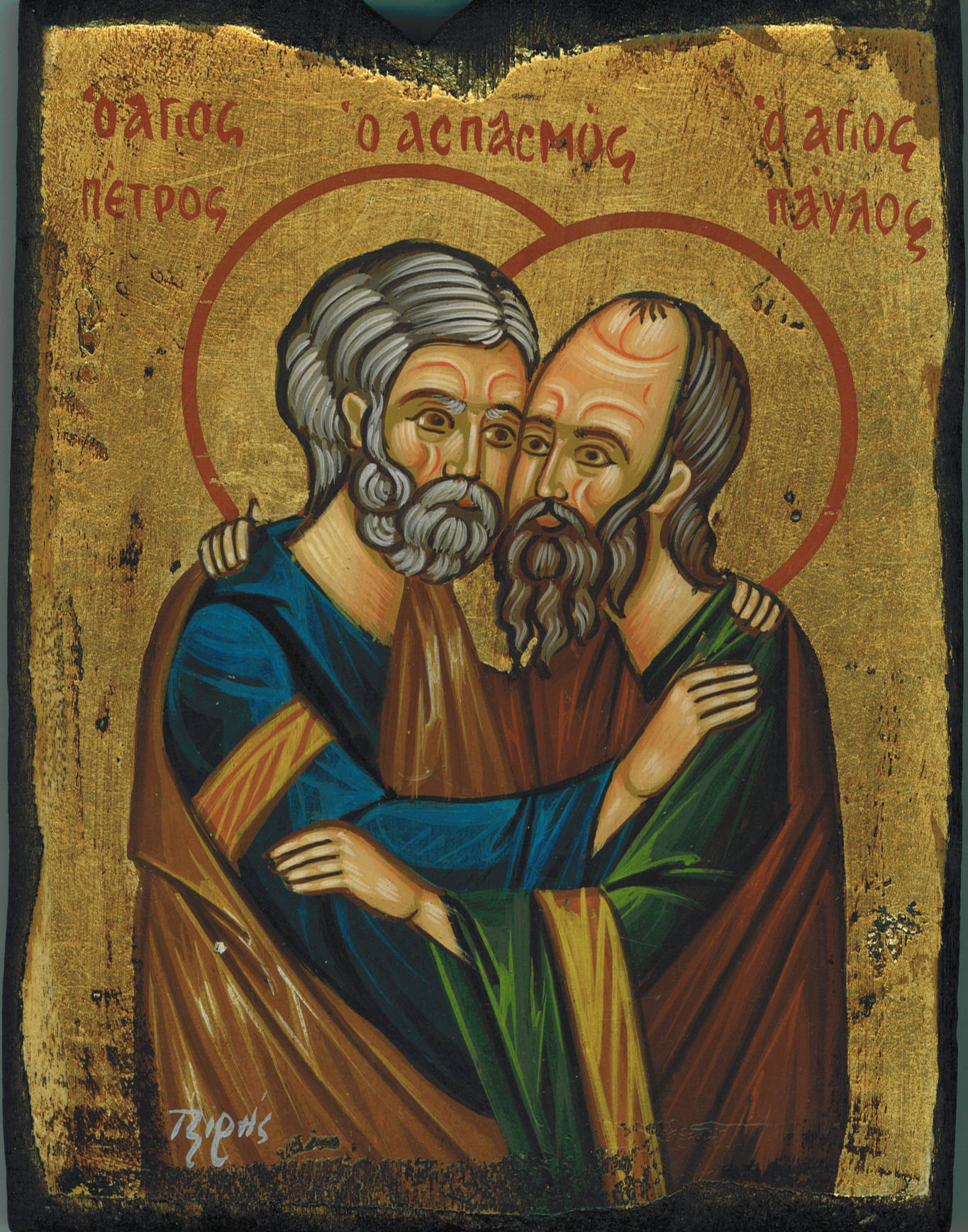
What I said last Sunday – Feast of Saints Peter and Paul


Yesterday we kept the feast of Saint Peter and Saint Paul. Here’s what I said in my sermon.

Icon

No matter the question, the answer is always ‘Jesus’. Anyone in the Church who works with children knows that problem. The answer to everything is Jesus!

The story is told of the Sunday School teacher who wanted to teach the children about the importance of being prepared and working hard. So she started her lesson by saying, “I’m going to describe something and when you know what it is put your hand up.” And off she went, “I’m thinking of something that lives in trees…” Nothing. “And it eats nuts…” Nothing. “It has a long bushy tail and can be grey or red…” Still nothing. Then, slowly, one boy put his hand up. The teacher breathed a sigh of relief and said, “Well, Freddie, what do you think it is?” And Freddie replied, “Well, it sounds like a squirrel to me, but I know the answer’s supposed to be ‘Jesus’” Continue reading

What I said this Sunday – Trinity 3 (Proper 6)


Here’s my sermon for this week. I used the gospel reading, the story of the sinful woman who anointed the feet of Jesus at the house of Simon the Pharisee. Essentially the story of two people who for their own very different reasons sought out Jesus.

Luke 7.36-8.3

In some churches it is the custom for the preacher to give their sermon a title. It’s not something that’s every really taken on in the Church of England, but it’s actually not a bad habit for the preacher to get into. It helps to focus the mind on the what message from the  Scripture reading is about. So today, I’m giving my sermon a title: The Importance of Being Earnest. Most of you will, of course, recognise immediately the reference to Oscar Wilde and his most famous play. As I read this gospel reading a number of famous Oscar Wilde quotes came to mind, so as we think about the woman who was a sinner and who washed the feet of Jesus, Oscar Wilde will today help us reflect on what we are being taught by sharing with us some of his most famous quotations. I’m tempted to say, as Oscar himself once said, “I wish I had said that,” but he often puts things so well – and so much better than I can. Continue reading

What I said a week last Sunday – Trinity 1 (Proper 4)


This week we had a family service with all our uniformed groups on parade. It was a fairly informal talk and mainly preached from a few notes. It’s not possible to post it, but I realised I had completely forgotten to post last week’s sermon, so here it is. The gospel reading for the day was the story of the healing of the centurion’s servant.

Luke 7.1-10

Mothers are full of pearls of wisdom. A survey by Clinton’s Cards last year discovered that on average mothers pass on 41 pearls of wisdom to their children. I hope you all listened to the pearls of wisdom that were passed to you as you were growing up. When asked people remembered being given such good advice as:

  • No 33: Don’t eat cheese before bed.
  • No 28: Don’t leave the house with wet hair.
  • No 20: Watching too much TV will make your eyes go square.
  • No 11. Always wear clean underwear.

Such things might seem rather flippant. And you may remember growing up and being given such good advice! I have to say that the one recurring instruction that I remember being given by my mother isn’t in the list: Do as you’re told and don’t ask questions! She would have made an excellent Roman centurion!

Amusing though those pearls of wisdom may seem, many of the pearls of wisdom given by mothers and recorded by Clinton’s are universal. And it would seem that somewhere along the way they have been picked up by the Roman centurion we hear about in today’s gospel reading. Remember that he is an officer in an army occupying a particularly difficult province in the Roman Empire. The Jews didn’t much like Romans and the Romans didn’t much like the Jews. He was someone who knew full well that he was in a position to be like my mother: Do as you’re told and don’t ask questions. And yet here we have a centurion who is clearly aware of and lives by – perhaps unusually for someone in his position – some of the motherly pearls of wisdom that appear at the top of the list:

  • No 15: Treat others how you wish to be treated yourself.
  • No 10: Treat people with respect.
  • No 5: If you don’t ask you don’t get.
  • No 1. Always try your best.

Treat others how you wish to be treated yourself – he has a slave whom, we are told, he values highly. He cares for him and when he takes ill he wants to do something about it. He could have thought, ‘I’ll get another slave,” but he doesn’t. What he does is seek to have the slave made well.

Treat people with respect – which he does in a remarkable way. Remember, this is an officer in an army of occupation. And yet not only has he treated the Jews with respect, he has built them a synagogue. And the love he has shown for the Jewish people has resulted in the Jewish elders supporting his request.

If you don’t ask you don’t get – and the centurion must have known that he had no right to ask and no right to expect that Jesus would respond to him, a Gentile. And yet he has enough faith in this Jewish teacher to know that Jesus has the power to heal his slave. And he’s only going to find out if Jesus will do it by asking.

Always do your best – and that’s clearly how this centurion is trying to live. He has tried his best in spite of the difficulties of being a Roman soldier trying to keep order in a difficult situation to not just get along with the local people but to help them. He is trying his best to find healing for his slave. This was clearly a highly unusual man given his role. So unusual that even Jesus is surprised by him, and he comments on his great faith – faith that he hasn’t found in his own people.

We hear in our gospel reading how the centurion sends the Jewish elders to Jesus with the request that Jesus come and heal his slave. They support his request, urging Jesus to come and help. And yet when Jesus is near to the centurion’s house he sends his friends out to meet Jesus. Perhaps he did this because he assumed that Jesus, a Jew, wouldn’t enter the house of a Gentile because of the constraints of the Jewish Law. And he sends them with a message: “Lord, do not trouble yourself, for I am not worthy to have you come under my roof; therefore I did not presume to come to you. But only speak the word, and let my servant be healed.”

Today, I want you to think about those words of the centurion, and to imagine that he is passing a pearl of wisdom on to you. He spoke those words through his friends with complete faith that Jesus would answer his request. A little later in our communion service we too will use words based on that request. And the pearl of wisdom that we have from the centurion is that as we approach the altar to receive Jesus in the bread and wine, is to ask with the same level of faith as the centurion for healing from Jesus and believing that he will do what we ask.

For those words, of course, have found themselves in a slightly altered form in our communion service. Traditionally they were: Lord, I am not worthy that thou shouldest come under my roof, but speak the word only and my soul shall be healed. In Common Worship they have been simplified to: Lord, I am not worthy to receive you, but only say the word, and I shall be healed.

We probably just say the words each week automatically. But today I want you to think about them: Lord, I am not worthy to receive you, but only say the word, and I shall be healed. Each of us knows that we are not worthy to receive Jesus, just as the centurion knew that he was not worthy. And yet Jesus still comes to us and gives himself to us. As you prepare to receive Jesus in the form of bread and wine today, think about what healing you need in your life. We’ve all got things that we know Jesus needs to sort out – physical, spiritual things that need his healing. And as you say those words –  only say the word and I shall be healed – believe that he will heal you. Have the faith that he had.

Learn from the wisdom of the centurion. Reach out in faith. And know that as you reach out your hands to receive the bread and the wine, the body and the blood of Jesus – or as you bow your head to receive a blessing – that Jesus has truly come to you. He has come under your roof and spoken words of healing right to your very soul.


My sermon for Trinity Sunday


Today, Trinity Sunday, I preached on the wonderful hymn Saint Patrick’s Breastplate.

The press sometimes seems to take great delight in quoting one survey or another claiming to show that religious belief is in decline. Actually not true although patterns of churchgoing have changed – and in this diocese at least we have begun to see some growth. But there is one area that we have seen real decline – and that is in the length of hymns that churchgoers are apparently willing to sing. And even clergy. One well-known broadcasting cleric tweeted not long ago that no hymn should be more than four verses unless it’s for a procession. And you can measure this decline in the acceptable length of hymns by looking back at our hymn books. Continue reading